Is It Really Micromanagement—or Is Something Else Going On?
Jul 21, 2026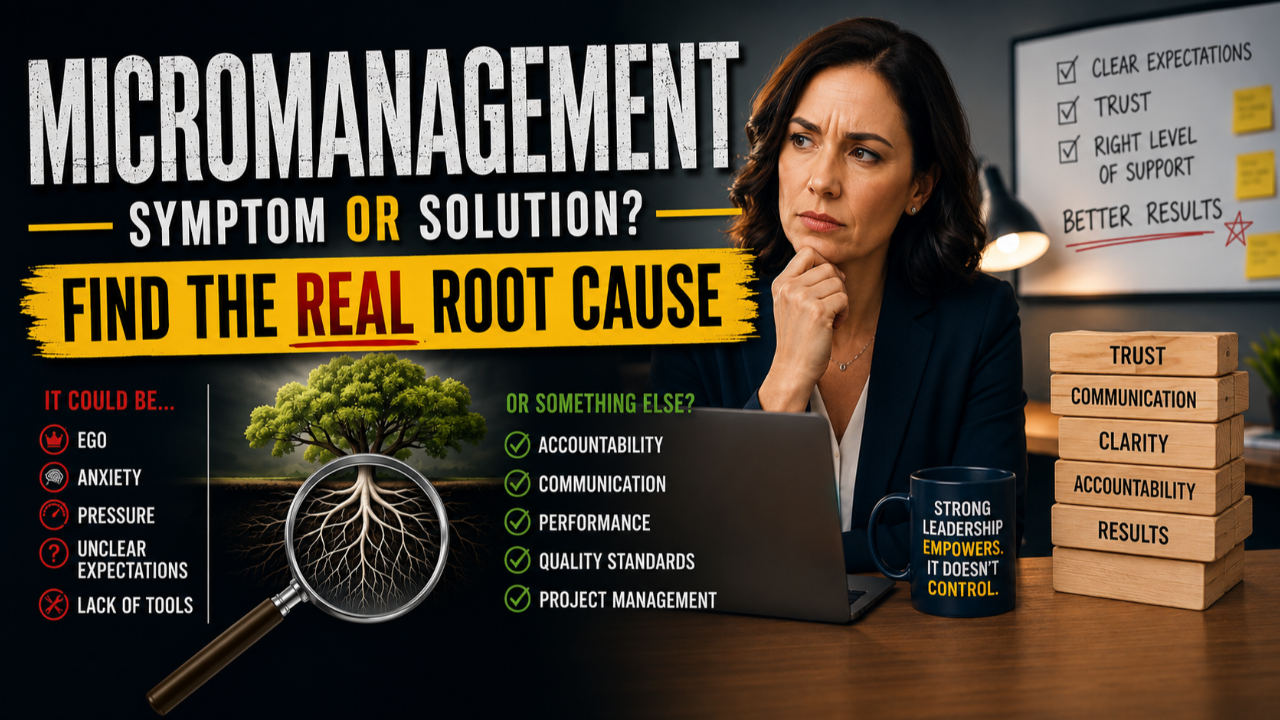
We are often told to find the root cause of a problem, and for the most part, that is very good advice.
That is why I want to talk about a topic we explore during August as part of The Fellowship Leadershit: From Missteps to Mastery.
Micromanagement.
It is a word that gets used frequently in workplaces, but I am not always convinced we are using it accurately.
Micromanagement is commonly defined as a leadership style in which a supervisor excessively controls or closely monitors the details of an employee’s work. Instead of delegating responsibility and trusting the employee to exercise judgment, the manager dictates exactly how the work should be completed.
On the surface, that feels like a comprehensive definition. The challenge is that micromanagement is often a symptom of something deeper.
Sometimes it is about ego or control. Sometimes it is anxiety. Sometimes it is pressure from senior leadership. Sometimes the manager has never been given clear decision-making authority, strong organizational systems, or the leadership tools needed to effectively delegate.

And sometimes what feels like micromanagement is actually an accountability, communication, or performance issue.
In my career, I have only been described as a micromanager once—and frankly, it shocked me.
I had inherited a team that had not been consistently following several basic organizational policies. Their previous manager had not enforced those expectations, so when I began requesting compliance, there was immediate resistance.
My intent was not to control the team’s work. My intent was to protect them.
Many of the policies were designed to ensure that employees had support when emergencies occurred, that the organization had the information it needed, and that the team could focus its time and energy on the work that mattered most.
I firmly believe that when leaders clearly identify the mission and establish meaningful goals, their role becomes protecting the team’s time and resources and removing barriers that prevent people from succeeding.
However, when the basic expectations are unclear or inconsistently enforced, leaders can end up spending all their time managing the small things. The team never gets the opportunity to focus on the bigger picture.
There are also many leadership behaviors that may look or feel like micromanagement but could actually be something else.
Frequent check-ins may be an attempt to provide support, stay informed, or prevent surprises.
Detailed instructions may be necessary because an employee is learning, a process is unclear, or the task carries significant risk.
Regular progress updates may be required because of deadlines, reporting expectations, or commitments made to clients and senior leaders.
Reviewing work before it is finalized may be part of quality control, coaching, compliance, or a normal approval process.
Asking questions may be an effort to understand the work rather than control it.
Specific deadlines, milestones, or documentation requirements may simply be effective project management.
Closer involvement with a new employee may be part of onboarding and skill development.
Increased oversight after missed deadlines or repeated mistakes may be a response to a legitimate performance concern.
Monitoring workload may be an attempt to prevent burnout rather than an effort to control how someone spends every minute.
The important distinction is usually found in three areas: purpose, duration, and pattern.
Supportive oversight should decrease as trust, competence, and consistency increase.
Micromanagement remains controlling even after an employee has demonstrated that they can perform the work successfully.
So how do we distinguish between a management issue and an employee issue?
It is more likely a management issue when expectations are unclear, constantly changing, or communicated differently to different people.
It is a management issue when a leader insists on approving nearly every decision, including low-risk decisions that should belong to the employee.
It is a management issue when experienced, high-performing employees are managed exactly like new or struggling employees.
It is a management issue when people are told to take ownership but are not given any real authority.
It is a management issue when the leader is more focused on controlling the method than evaluating the outcome.
It is a management issue when check-ins primarily exist to manage the leader’s anxiety.
It is a management issue when employees are afraid to make decisions because they expect their work to be taken over, rewritten, or criticized.
And it is a management issue when the level of oversight never decreases, regardless of how much competence or reliability an employee demonstrates.
These patterns can come from ego. They can come from pressure higher in the organization. They can come from unclear roles or decision rights. They can also come from leaders who have never received meaningful support in developing the tools required to lead effectively.
Hello—cue the Fellowship.
However, the issue may be more employee-driven when expectations have been clearly communicated, deadlines are repeatedly missed, agreed-upon updates are not provided, feedback is ignored, or the employee expects autonomy without demonstrating the reliability and judgment required to sustain it.
Most of the time, the truth is somewhere in the middle.
The manager may need to communicate expectations more clearly, explain why oversight has increased, and identify what the employee must demonstrate to regain autonomy.
The employee may need to improve communication, follow-through, consistency, or willingness to ask questions before problems occur.
Returning to the team that once labeled me a micromanager, there was an important lesson for me.
When an organization does not clearly define its non-negotiables—basic policies, communication expectations, decision rights, and performance standards—every manager is left on an island trying to interpret and enforce expectations independently.
Then, when teams move from one manager to another, even basic structural changes can create significant conflict.
One manager may have ignored a policy. Another may have enforced it. The employee experiences the change as control, while the manager experiences the resistance as a performance problem.
That is not simply a manager issue or an employee issue.
It is an organizational clarity issue.
Strong leadership is not the absence of accountability, expectations, or oversight. It is the ability to apply the right level of support and structure for the person, the task, and the risk involved—and then adjust that level as trust and capability grow.
Before labeling a leader a micromanager, we should ask:
Are expectations clear?
Is the oversight proportional to the risk?
Is there a documented performance concern?
Does the employee understand what greater autonomy requires?
And will the leader actually step back once trust and competence have been demonstrated?
Those questions will usually reveal whether the root problem is control, performance, communication, or organizational confusion.
This is exactly the kind of real-world leadership challenge we explore in Leadershit: From Missteps to Mastery—because leadership growth does not come from pretending we always get it right. It comes from examining the moments when leadership gets messy, identifying what is really happening, and developing better tools for the next conversation.
Organizations and teams can learn more through the facilitated Leadershit Workshop - SCHEDULE HERE, where participants unpack common leadership missteps and practice healthier approaches to accountability, trust, communication, and decision-making.
For leaders who prefer to work through the content independently or with their own team, the Leadershit Self-Paced UnCourse provides flexible learning, practical reflection questions, and tools that can be applied immediately.

Because sometimes the problem is micromanagement.
Sometimes it is performance.
Sometimes it is unclear expectations.
And sometimes, before we can solve the problem, we simply need to name the right one.
Grab ONE copy on amazon, or buy in bulk on our website so your team can go through it together. Find the full library and purchase request from HERE
We also want to remind you that Rise and Thrive 2028 Registration is OPEN!!! We’re going International - We have a mansion reserved in Playa Del Carmen, and you can put your deposit in and make payment select your preferred payment terms when you sign up! We can’t wait to see 12 incredible women join us for an unforgettable 5 days and 4 nights!
LEARN MORE HERE Not sure if it’s for you, but want to ask some questions? Schedule a chat with either of The Ch(K)ristines and see if the Rise and Thrive retreat can elevate your leadership practice!